International Journal of Psychology and Strategic Communication
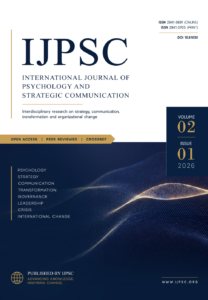
Upcoming Volume 2, Issue 1: Call for Papers – still open
We invite researchers, scholars, and practitioners to contribute to Volume 2, Issue 1 of the International Journal of Psychology and Strategic Communication, focusing on contemporary challenges in global management, strategic transformation, and organizational resilience.
This issue brings together research on global transformation under conditions of uncertainty and structural change. It addresses key challenges in international management, including innovation processes, strategic governance, risk assessment, and cross-cultural collaboration. A central focus is how organizations adapt to dynamic environments shaped by globalization, digitalization, and geopolitical instability.
A particular emphasis is placed on management under conditions of disruption and crisis. Contributions examine strategic decision-making and organizational behavior in contexts of economic volatility and uncertainty, offering insights into resilience, adaptability, and leadership under pressure.
Further contributions explore corporate governance, sustainability, international expansion strategies, and risk management systems in volatile environments. Collectively, these studies highlight the need for strategic approaches that integrate ESG considerations, technological change, and systemic risk.
Reflecting the journal’s interdisciplinary scope, this issue engages with themes such as innovation management, internationalization, strategic adaptation, risk governance, organizational transformation, cross-cultural communication, sustainability, and crisis management.
Together, these contributions provide insights into how organizations can navigate uncertainty while maintaining competitiveness and long-term development.
We invite readers to explore the full issue and engage with the ongoing dialogue on strategy, communication, and global transformation.
IJPSC | Volume 2, Issue 1, approx 06/26
Strategies for Change, Innovation and Transformation
ISSN: 2941-5691 (Online)
ISSN: 2941-5705 (Print)
doi: 10.61030
The International Journal of Psychology and Strategic Communication is an interdisciplinary journal exploring how organizations, institutions, and societies navigate strategic change, innovation, and transformation. We provide a platform for forward-thinking research and practical insights across psychology, communication, and a wide range of related fields.
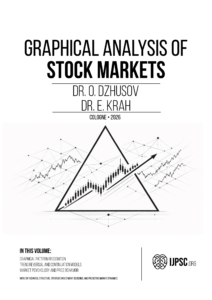
Book Announcement: Graphical Analysis of Stock Markets

Financial markets often appear rational, but in reality they are strongly influenced by human behavior, including fear, optimism, hesitation, and panic. This book is based on that perspective.
Graphical Analysis of Stock Markets presents price charts as a structured representation of collective investor behavior, where recurring patterns reflect decision-making under uncertainty.
The book provides a structured overview of core analytical tools and classical chart formations, explaining their interpretation and practical use. Using real market data, it shows how patterns emerge and how they can be applied in practice.
A strong emphasis is placed on application. Investment approaches based on chart-based models are discussed and critically evaluated in light of current market conditions. The aim is to improve analytical judgment rather than provide certainty.
A key contribution is the introduction of the MDI (Modified Dow Indicator), an early-warning tool for identifying potential market corrections and downturns. Based on empirical testing since 1998, it offers a systematic approach to assessing market risk.
The book combines theory, empirical evidence, and practical application. It is intended for investors, analysts, and students seeking a deeper understanding of market behavior and price dynamics.
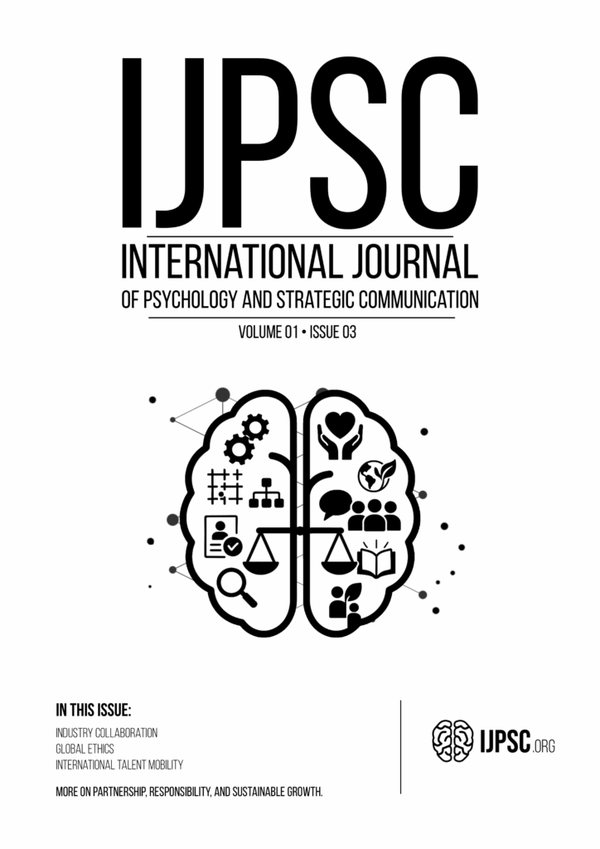
Volume 1 – Issue 3 of the International Journal of Psychology and Strategic Communication is now available.
This issue brings together research focused on strategic cooperation, organizational transformation, and decision-making in global contexts. The contributions address topics such as university–industry collaboration, digital leadership and competency development, ethics and corporate responsibility, ESG risk management, and international market strategies. Across these works, a shared perspective emerges: strategic progress today requires not only expertise, but the capacity to collaborate, reflect, and adapt in complex environments.
This edition is also closely connected to the ongoing academic cooperation between Oles Honchar Dnipro National University (Ukraine) and the International University of Applied Sciences Cologne (Germany). The continuity of this partnership demonstrates that academic exchange can remain stable, constructive, and future-oriented—even under challenging conditions.
ISSN: 2941-5691 (Online)
DOI: 10.61030
We invite readers, researchers, and practitioners to explore the full issue and join the ongoing dialogue on strategy, communication, and global transformation.
Featured Article
PARTNERING WITH ACADEMIA: INDIRECT INDICATORS OF SUCCESS
Peter Egorov (2025), International Journal of Psychology and Strategic Communication — Vol. 01, Issue 03
DOI: https://doi.org/10.61030/MTCR3782
Summary:
Industry stakeholders invest heavily in academic collaborations, making it essential to define success measures. Evaluating UIC helps focus efforts and allocate resources effectively, yet assessing knowledge value and partnership status is challenging due to their dynamic nature. These complexities hinder the establishment of rigid success criteria. To address this, we conducted semi-structured interviews with executives from global conglomerates across 13 industries. This diverse sample allowed us to examine direct and indirect metrics used by multinational companies to assess academic partnerships. We analyzed best practices and assessment frequencies, developing a comprehensive scheme of proxy indicators. This framework incorporates qualitative and quantitative measures, capturing both success factors and failure indicators. Our findings fill a gap in industry perspectives on UIC, offering an extensive, inductively derived scheme of proxy indicators. These reflect industry considerations regarding success, failure, and partnership evaluations. By expanding theoretical evidence and refining proxy measures, our research provides new insights into academic collaboration assessment.

Introduction:
Being aware of the success measures and evaluations of university-business collaborations allows participants to focus their efforts, account for behavior, and manage the way the resources are allocated (Koppenjan 2008). Industry participants spend considerable amounts on academic collaborations (Perkmann et al. 2011), and this expenditure necessitates to be justified. Therefore, it is important for businesses to be able to assess the state of their partnerships and collaborations. The aptitude to quantify the value attained through collaborative activities, proves to be difficult even when the worth is evident (Perkmann et al. 2011).
Recent studies (Al-Ashaab et al. 2011; Albats et al. 2018; Mora-Valentin et al. 2004; Rossi & Rosli 2014) provide some success factors for the evaluation of the university industry alliances, which whilst valuable, do not exhibit any specific metrics (Perkmann et al. 2011). The latest endeavor by Frølund and Riedel (2018) explicitly elaborates on five vital best practices for academic collaborations, taking the rarely addressed industry perspective. While contributing significantly to the systemization and support of setting up an efficient collaboration network for the industry (Frølund & Riedel 2018), the literature nonetheless lacks proxy indicators which would allow researchers and managers to account and measure for benefits outside of the direct project outputs (Perkmann et al. 2011).
Understandably, success measures are likely to differ greatly from stakeholder to stakeholder, as a collaborative environment entails multifaceted perspectives of the participants due to contrasting disciplinary approaches and organizational bias (Head 2008a). Such a cultural divide poses challenges not only in the decision making process but also in the success and the assessment of a collaboration’s performance (Rajalo & Vadi 2017). It is vital to recognize that all institutions differ by their strategy, goals, areas of research, industry etc. Hence, to derive the suitable KPIs (key-performance-indicators) for the success of UIC, case-specific metrics need to be applied from a broad set of metrics, which would allow the evaluation to be best tailored to the collaborative activities at hand (Rossi & Rosli, 2015).
Due to a lack of literature investigating the industry perspective regarding success measures of university relations (Perkmann et al. 2011; Skute et al. 2019; Albats et al. 2018), our research seeks to explore and develop a scheme of proxy indicators for evaluating the effectiveness and success of an organization’s academic collaborations. We address this with our research question – what proxy measurements of success can businesses utilize to assess their collaborative partnerships with academia?
Through semi-structured interviews, we inductively examine the existing direct and indirect measurements which large multi-national companies utilize to determine success of their UIC partnerships. Taking into consideration the absorptive capacity, economies of scale, and the Schumpeterian hypothesis (Tsai 2009; Fontana et al. 2006; Laursen & Salter 2004; López et al. 2015) – investigating what indicators of success specifically the larger enterprises consider in terms of UIC partnerships, is deemed fit. Proxy indicators for business to assess UIC is derived through qualitative and quantitative measurements, where the success factors and failure indicators are considered. An important role is attributed to the frequency as well the internal hierarchy at which the varying levels of evaluations take place. This research seeks to address the literature gap of the underrepresented industry perspective in UIC in terms of how success can be facilitated in academic partnerships. Moreover, this paper presents a novel scheme of proxy indicators of success shaped through success factors, failure indicators, qualitative and quantitative indicators. These are further appropriated with the corresponding stages of collaboration development. This interconnection allows for this scheme to be applied as a tool for other industries or academic institutions to advise and facilitate success within their partnerships.
Read the article: https://doi.org/10.61030/MTCR3782
We’re pleased to announce the release of Issue 3 (2025)
This issue brings together current research on major global developments. In particular, it explores the ethical and strategic dimensions of artificial intelligence, ESG-related risks in international finance, and corporate social responsibility in cross-cultural contexts. A recurring theme throughout the contributions is the importance of co-creation in international settings. Global business transformation is increasingly shaped by co-creation across areas such as adaptive marketing strategies, cross-border human resource practices, and collaborative innovation.
Featured Contribution: Typology of Industrial Collaborative Ideals
Dr. Peter Egorov and Dr. Natascha Eckert present a pioneering typology of how companies engage in University-Industry Collaboration (UIC). Based on 20 interviews with senior executives from multinational corporations, the study identifies five strategic collaboration models – ranging from informal “Situationships” to complex “Innovation Ecosystems.” The article offers valuable insights into how firms structure, support, and embed academic partnerships within the Triple Helix framework.
https://doi.org/10.61030/NKCS9124
Reflecting the journal’s interdisciplinary mission, this issue highlights key concepts such as: global expansion, business internationalization, trade barriers, stakeholder engagement, expatriate strategies, AI ethics, sustainability, HRM in transnational contexts, and strategic communication. Together, these contributions offer valuable perspectives on the challenges and opportunities of operating in a complex, interconnected world.
We invite you to explore the full issue and engage with the ongoing dialogue on strategy, communication, and global transformation.
IJPSC | July 16, 2025, Editors-in-chief
Strategies for Change, Innovation & Transformation – ISSN: 2941-5691 (Online) – ISSN: 2941-5705 (Print) – doi: 10.61030
The International Journal of Psychology and Strategic Communication is an interdisciplinary journal exploring how organizations, institutions, and societies navigate strategic change, innovation, and transformation. We provide a platform for forward-thinking research and practical insights across psychology, communication, and a wide range of related fields.
Aims & Scope
We welcome contributions from across disciplines, including:
- Business & Management
- Economics (Micro & Macro)
- Finance, Accounting & Corporate Strategy
- Entrepreneurship & Innovation
- Project & HR Management
- Digital Transformation & Marketing
- Supply Chain & Sales Management
- Business & Commercial Law
- Political Strategy & International Relations
Core Topics
- Strategic governance and change
- Corporate policy and leadership
- Change management in politics and society
- Stakeholder engagement and communication
- Innovation risks and opportunities
- Sustainability and future resilience
- Global perspectives: EU, USA, and Asia
For Researchers, Leaders & Change-Makers
We invite scholars, business leaders, consultants, and policymakers to join the conversation. Submit your work, collaborate on future-focused projects, and help shape the dialogue on change in an increasingly complex world.
- ISSN: 2941-5691 (Online)
- ISSN: 2941-5705 (Print)
- doi: 10.61030/
Volume 01, Issue 02
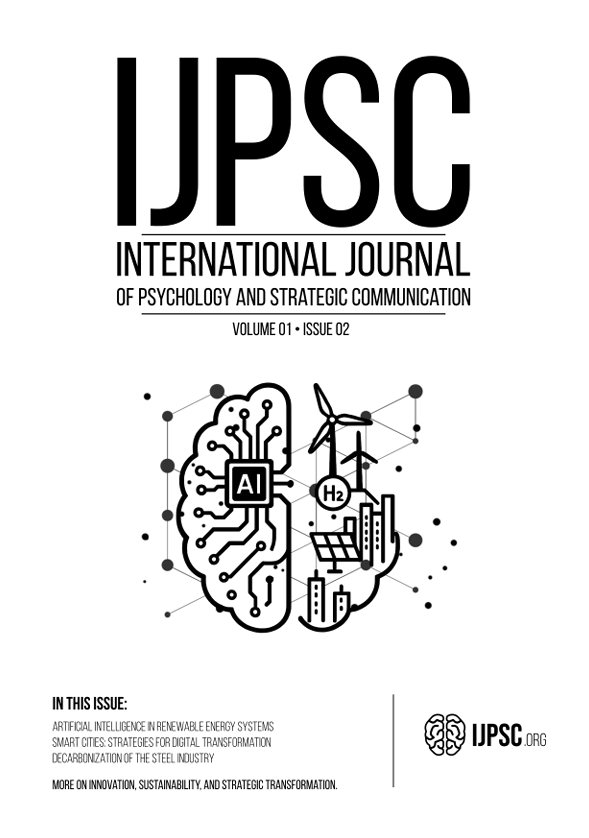
We are pleased to announce the publication of Volume 01, Issue 02 of the International Journal of Psychology and Strategic Communication (IJPSC).
This latest issue highlights current research at the crossroads of artificial intelligence, international management, behavioral finance, and global communication. In a time shaped by technological disruption and strategic uncertainty, the articles in this edition offer actionable insights into how organizations and societies adapt, communicate, and lead across borders.
Topics featured in this issue include:
- Ethical AI in international business
- Cross-cultural team leadership
- Crisis management in multinational enterprises
- Behavioral finance and investment strategy
- Logistics and trade in the context of EU–Ukraine cooperation
- Smart city development and sustainability
- Gender equality and ethical leadership in global HR
The issue was developed in close collaboration with academic partners across Europe, including strong contributions from scholars based in Ukraine. It reflects the journal’s ongoing commitment to promoting open-access, interdisciplinary research with global relevance.
All articles are freely available online and have been assigned DOIs to ensure maximum visibility and long-term citability.
Read the full issue here: Volume 01 – Issue 02
For updates and submission opportunities, follow us on [LinkedIn / Twitter / Mastodon] or visit our journal homepage.
Highlighted Recent Publications
- Zhurakovska, A.; Olyinik, A. (2025): Assessment of the Effectiveness of Strategic Management of Investment Activities of Enterprises in Times of Crisis. 310. https://doi.org/10.61030/DYOV8050
- Shvedenko, T.; Litvinova, V. (2025): Digital Transformation in International Management: How Technology Is Changing the Management of Global Operations. 302. https://doi.org/10.61030/LSAE4668
- Stoianov, V.; Ukhanova, I. (2025): Creation and Managing of Added Value Chains in the Conditions of Globalization. 292. https://doi.org/10.61030/EEUU1813
- Pyvovarska, A.; Voronova, O. (2025): Optimization of International Logistics Processes as a Strategy for Increasing the Efficiency of the International Management of Ukrainian Companies. 284. https://doi.org/10.61030/NUYP8380
- Kosman, A.; Pashchenko, O. (2025): Current Trends in the Development of EU Foreign Trade in Metallurgical Products. 277. https://doi.org/10.61030/KQLY5228
- Mykhailenko, O.; Pavlov, R. (2025): International Trade in Medical Goods: Lessons from the COVID-19 Pandemic. 266. https://doi.org/10.61030/YCOJ2940
- Slobodian, M.; Ukhanova, I. (2025): Problems of International Management of Ukraine’s Foreign Trade Policy in Trade in Goods in the Context of Integration with the EU. 257. https://doi.org/10.61030/IIHR4637
- Kyrmykchy, S.; Husenko, O. (2025): The AI’s Ethical Use Features in the Conditions of International Business Management Implementation. 250. https://doi.org/10.61030/SIWG4068
We invite academics, practitioners, and policymakers to engage with this evolving body of work—and to contribute to future issues that reflect the complexity and interconnectedness of today’s global challenges.
International Journal of Psychology and Strategic Communication
Strategies for Change, Innovation & Transformation
ISSN 2941-5691 (Online) | ISSN 2941-5705 (Print)
DOI prefix: 10.61030
Ukraine Digital – Supporting Higher Education in Times of Crisis
As part of the DAAD-funded program “Ukraine digital: Ensuring Academic Success in Times of Crisis,” Mittweida University of Applied Sciences has partnered with the National University of Economics in Odessa (ONEU) and the National Oles Honchar University in Dnipro (DNU) to support Ukrainian universities in implementing and sustaining digital educational offerings.
The ongoing conflict in Ukraine has severely affected the higher education system, with many university buildings damaged or destroyed and numerous faculty members and students forced to leave the country. Despite these challenges, Ukrainian universities have begun to leverage digital teaching methods to provide their students with continuous education.
The “Ukraine digital” initiative focuses on two main objectives: firstly, the transfer of educational materials across 27 disciplines to partner universities to address existing gaps in the education system; and secondly, the enhancement of digital competencies through the application of modern e-learning platforms and methods. Additionally, Mittweida University of Applied Sciences offers financial support through scholarships for Ukrainian students, both those who remain in the country and those who come to Germany.
In the coming years, the project will continue to expand upon established measures and develop further initiatives that cater to the needs of students and universities in Ukraine. The overarching goal is to sustainably improve digital education and establish stable partnerships to strengthen the academic landscape in Ukraine.
For more information, please contact Hochschule Mittweida or visit our website Ukraine digital: Studienerfolg in Krisenzeiten sichern – DAAD. Ukraine digital | HS Mittweida
Issues and Special Editions
Download Journal All issues are also available as print copies.This special issue of the International Journal of Psychology and Strategic Communication (IJPSC) is published within the framework of the DAAD-funded initiative Ukraine Digital: Ensuring Academic Success in Times of Crisis. The initiative was established to support Ukrainian universities in the implementation of digital teaching and to enable students to continue their academic studies under exceptionally challenging circumstances.
Despite the profound disruptions caused by the ongoing war, Ukrainian students and academic staff have demonstrated remarkable commitment to scholarship, innovation, and academic continuity. The contributions presented in this issue are the result of academic collaboration between Mittweida University of Applied Sciences, Odesa National Economic University, and Dnipro National University. Collectively, the articles reflect scholarly quality, critical reflection, and an international perspective aligned with the mission of the journal.
Acknowledgment is also due to all authors, coordinators, and supporting staff whose dedication contributed to this publication, as well as to the German Academic Exchange Service (DAAD) for supporting this international academic collaboration. This special issue stands as a testament to the enduring importance of academic cooperation, resilience, and intellectual exchange in times of uncertainty.
Project manager – Ukraine Digital
Hochschule Mittweida